
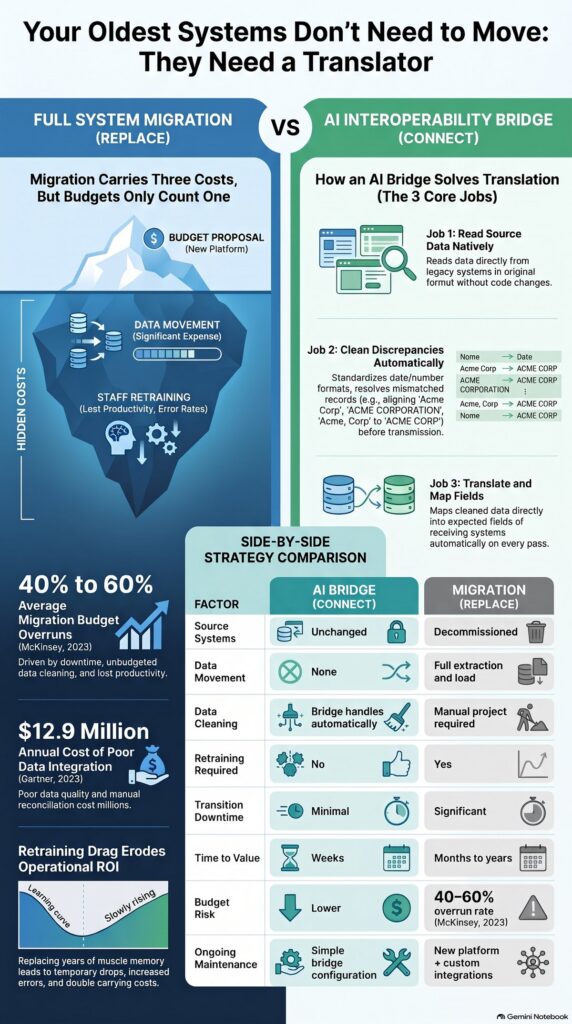
Migrating a system sounds like the answer to interoperability issues with other systems. A new system, and the ability to have data move between systems. But migration carries three price tags, not one: the new system, the cost of moving the data, and the cost of retraining every person who touches that data daily. Most budget conversations stop at the first price tag. The other two show up later, and they routinely blow the project.
The organizations I work with often run systems that are ten, twenty, sometimes thirty years old. The data in those systems is accurate. The people who use those systems are trained. The problem is that three systems hold the same facts and none of them can talk to each other. That is a translation problem, and translation costs far less to solve than migration.
Key Takeaways
- Migration carries three distinct costs. Most budget conversations only count one.
- Siloed systems that hold the same data create manual work because no translator exists between them – the data itself is sound.
- An AI bridge reads, cleans, and translates data between systems without touching the systems themselves.
- The people who use those systems keep working exactly as they do today. No retraining required.
- Connecting existing systems costs less than replacing them, and AI has made that connection practical at a scale that was not realistic five years ago.
Migration Budgets Consistently Overrun by 40 to 60 Percent – and Retraining Is Why
According to McKinsey’s 2023 technology transformation research, migration budget overruns land between 40 and 60 percent. Those overruns do not come from the new system. They come from data cleaning, downtime, and retraining.
This pattern appears consistently across my advisory work with mid-market operations teams. The organization budgets for the new platform. The vendor quotes a migration fee. Both numbers go into the proposal, and the proposal gets approved. Then retraining starts. Then downtime accumulates. Then someone discovers that the data does not map cleanly from the old format to the new one, and a cleaning project appears that nobody scoped.
Retraining is the cost that surprises people most. The team spent years building muscle memory around the old system. Replacing that muscle memory takes time, and during that time, productivity drops. Errors go up. Workarounds multiply. The organization ends up paying the old system’s carrying costs and the new system’s learning curve simultaneously.
“The question worth asking before any migration proposal gets approved: what does it cost to connect the systems you already have, rather than replace them?”
When Three Systems Share the Same Data, One Person Becomes the Human Translator
Here is a pattern that surfaces repeatedly across the operations teams I advise. Three systems exist inside the same organization. Each system holds overlapping data – a client name, an account number, a status, a balance. None of the systems can read the others.
A task gets submitted. The receiving system rejects it. Someone on the team opens the first system, finds the missing value, and sends it to the person who submitted the task. That person submits again. The system rejects again, this time asking for a value from a second system. The same person opens the second system, extracts the value, and sends it forward. The loop repeats until the task finally clears.
That person is functioning as a human translator between systems that speak different languages. The translation is accurate. The translation is also expensive, because it consumes hours that compound across every task, every day, every quarter.
Gartner’s 2023 data quality research found that poor data quality costs organizations an average of $12.9 million per year – a figure that reflects not just bad data, but the labor cost of manually reconciling data across disconnected systems (Gartner, 2023).
An AI bridge changes what happens in that loop. The rejection arrives. The bridge reads the rejection, identifies the missing value, pulls it from the correct source system, matches it to the format the receiving system expects, and resubmits. One pass. The old systems stay exactly where they are. Nobody touches them. Nobody migrates anything. Nobody retrains.
The person who used to perform that translation manually is now free to do work that requires judgment, not data retrieval.
An AI Bridge Does Three Jobs, and Data Cleaning Is the One That Prevents Cascading Errors
An AI bridge between legacy systems does not simply copy data from one place to another. Copying data between incompatible systems is how you create new errors. The bridge performs three distinct jobs.
First, it reads. The bridge reads the data from each source system in the format that system uses natively. The source systems require no changes.
Second, it cleans. Cleaning means making the data consistent before it moves anywhere. One system stores a vendor name as “Acme Corp.” Another stores the same vendor as “ACME CORPORATION.” A third stores “Acme, Corp.” To a human, those are the same vendor. To a system comparing fields, they are three different records. The bridge resolves that discrepancy before the data moves. Cleaning also handles date formats, number formats, field lengths, and any other structural difference that would cause a receiving system to reject the record.
Third, it translates. The bridge maps the cleaned data into the specific fields the receiving system expects. The field a receiving system calls “vendor_id” may correspond to a field the source system calls “supplier_code.” The bridge holds that mapping and applies it on every pass.
The old systems never change. The people who use the old systems never change how they use them. The bridge works in the background, and the manual translation loop stops.
Connecting Existing Systems Costs Less Than Replacing Them – Here Is the Full Comparison
| Factor | AI Bridge (Connect) | Migration (Replace) |
|---|---|---|
| Source systems | Unchanged | Decommissioned |
| Data movement | None | Full extraction and load |
| Cleaning responsibility | Bridge handles it | Migration project handles it |
| Retraining required | No | Yes |
| Downtime during transition | Minimal | Significant |
| Time to value | Weeks | Months to years |
| Budget risk | Lower | 40–60% overrun rate (McKinsey, 2023) |
| Ongoing maintenance | Bridge configuration | New system plus any integration |
Organizations that have pursued bridge-first strategies consistently report faster time to value and avoided the retraining drag that erodes the ROI case for full migration.
Frequently Asked Questions
My team keeps asking for a new system. How do I know whether the friction comes from the system itself or from the gaps between systems?
Ask one question: is the data in the current system accurate? If the answer is yes, the system is working. The friction your team experiences almost certainly comes from moving data between systems. Manual exports, re-entry, reformatting, and copying values between screens are all translation problems. A bridge addresses translation problems directly.
We use SaaS platforms we don’t control. Can a bridge still work without access to the underlying code?
Yes. An AI bridge reads from whatever the platform makes available — exports, APIs, or both — cleans and translates the data, and writes to wherever it needs to go. Access to underlying code is not required. The platform vendor does not need to be involved.
What happens to the bridge when one of the legacy systems eventually gets replaced?
The bridge configuration updates to reflect the new system’s fields and formats. Every other system in the ecosystem remains unaffected. When a full migration replaces a system, every integration built around that system breaks simultaneously. When a bridge handles translation, updating one connection point does not cascade into the rest of the organization’s data flows. Changes stay contained.
About the Author: Audrey Kerchner is an AI strategy advisor at Inkyma who helps mid-market companies stop trading manual labor for system gaps. With extensive experience advising operations leaders on AI interoperability, she specializes in showing organizations how AI bridges eliminate the translation work that siloed systems have always required – without the cost or disruption of migration.
If the manual workarounds in your operation feel like a fixed cost, they probably aren’t. Tell us which process creates the most friction for your team right now.
